
DIRICHLET FUNCTION
The Concept Of Discontinuity - To Be Continued

In MetaPhilosophy (Latin: MetaPhilosophia), the focus is on rationalizing the abstract and making the rational realistic, so that hopefully the abstract can be understood intellectually (rationally - logically) and from rationality can be understood realistically (relevantly - objectively) as broadly as possible (relatively) or to the extent of universality (its absolute furthest limit).
If this is applied to analyze mathematical matters, then it should bring mathematical matters to be understood beyond symmetrical rationality in a realistic way (finding its objectivity in reality), SO THAT ITS MATHEMATICAL CERTAINTY can be used to realize its realistic certainty and to be made into a practical guide.
📌 IN SHORT, UNDERSTANDING THE OBJECTIVITY OF THE ABSTRACT SO THAT IT HAS PRACTICAL VALUE
And the greatest challenge is understanding the reality of mathematical rationality, so that its realistic side is also captured objectively.
💠 And this META function always underlies every step of metaphilosophizing.
Its current development discusses most recently touches upon the realm of mathematics with the theme of the Dirichlet Function.
✅ The initial stage of understanding the ‘Dirichlet Function’ is to comprehend the concepts of integers, rational/irrational numbers, and REAL numbers
✅ The initial stage of understanding the ‘Dirichlet Function’ is to comprehend the concepts of integers, rational/irrational numbers, and REAL numbers
INTEGER NUMBERS. Integers are like specific entities, for example the set of even and odd integers {-2, -1, 0, 1, 2} 🟰 {pair of 2, pair of 1, empty, something, two of something} 🟰 {minus two, minus one, neutral, at level 1, at level 2}.
✅ This means that integers can represent certain entities.
RATIONAL NUMBERS. Rational numbers are fractions composed of integers. A form of measurement, comparison, and scale. Or also approaching / distancing (zoom in / zoom out).
REAL NUMBERS. They are the foundation of all numbers.
DIMENSIONS OF TRUTH
In the concept of truth dimensions (absolute, relative, subjective, and objective), then “absolute 🟰 real numbers,” “relative 🟰 integers,” “subjective 🟰 rational numbers,” and “objective 🟰 their calculated result.”
✅ Subjectivity is adaptation – measurement – calculation that gives a definite (objective) result.
IRRATIONAL NUMBERS. What distinguishes them from rational numbers in decimal context is: no limit & no repetition.
Examples:
Rational: “0.5” (its decimal terminates)
Rational 22/7 = 3.142857142857143
Its decimal has a repeating pattern (”42857”)
Irrational “pi” 3.14159... (its decimal is unlimited & its decimal doesn’t repeat)
🎯 Even though the end of an irrational number is unknown, it doesn’t mean it’s not real (it remains part of NUMBERS - REAL)
Understanding Reality From Rationality
Every number is a symbol representing something. And irrational numbers cannot be written completely, does that mean irrationals are not real? Not really, because mathematics affirms where the logic of irrational numbers lies.
Irrational “pi” 3.14159... although it cannot be written completely, doesn’t mean it cannot be written down.
Irrational “pi” 3.14159 can be written on a line at coordinate points between 3 > “pi” (3.14159) > 4, “pi” 3.14159... exists in the middle between a value (greater than) the number 3 and a value (less than) the number 4
REALISTICALLY, it is understood that irrational numbers have reality (can be written down) but their complete range is only limited to being understood (knowledge)
REALITY & KNOWLEDGE
Here mathematics introduces the dimension of action, realistic interaction & the dimension of action, realistic only as knowledge”
D(x) = 1: If “x” is a rational number (e.g., 1/2, -3, 5)
D(x) = 0: If “x” is an irrational number (e.g., “pi”)
The D(x) function does not give many different possible outcomes, but only 2 types of results: “1” or “0”
Here’s what I mean:
f(x) = 2x
f(1) = 2
f(2) = 4
f(3) = 6
f(x) = 2x
f(3) = 6
f(5) = 10
f(7) = 14
Suppose “M” = “eating”
M(x) = 1 if x “eats chili”, 0 if “cake”
M(chili) = 1
M(cake) = 0
M(chili) = 1
f(x) is easily understood as formula(x). Or D(x) should become L(x) = Label(x)
Although we understand it easily as f(x) = formula(x) or D(x) = Designated(x), that’s just a trick to make understanding easier. Actually, the notation doesn’t point to that, but rather it’s the discoverer’s name where D(x) = Dirichlet(x)
We should first understand the agreed-upon format, so that when understanding it realistically, we don’t forget the rational foundation and its historical value (honoring the discoverer in the field of mathematics as the scientist D(irichlet)(x)
It’s like if the result of any formula calculation = odd, then its value is 1, or if the result of any formula calculation = even, then its value is 0
Similarly, numbers valued “1” or “0” in the Dirichlet function are used as markers (labels) for the calculation result values
IN SIMPLER TERMS...
Suppose y = 40x, and y is rational
Then D(y) = 1
Suppose y = 2x, and y is rational
Then D(y) = 1
Suppose y = result of any formula, and y is rational
Then D(y) = 1
For all formulas “?” the value remains “1” or “0” as a label
If “?” has a “rational” value, then it’s labeled with value “1”
If “?” has an “irrational” value, then it’s labeled with value “0”
Suppose y = 40x, and y is rational ➡️ D(y) = 1
Suppose y = 2x, and y is rational ➡️ D(y) = 1
Suppose y = result of any formula, and y is rational ➡️ D(y) = 1
ANALOGY
Like giving a red stamp for rational, blue stamp for irrational
Or like green light (1) & red light (0)
Or like checkmark ✅ (1) & cross ❌ (0)
Or like if “full” 🟰 1 & “hungry” 🟰 0
We find that the use of function D(x) doesn’t involve calculation but categorization
CALCULATION FUNCTION
f(x) = 2x
Input: x = 3
Output: 2 × 3 = 6
Output: 6 (calculation result)
CATEGORIZATION FUNCTION
D(x) = Dirichlet Function
Input: x = 3
Check property ➡️ 3 is rational
Output: 1 (label/category)
From the value of number 1 ➡️ 3 for example, there are many numbers in between, namely “1.5”, “2” or “pi”
✅ If the number is rational then it’s given value 1, or if the number is irrational then it’s given value 0 so that its graph can be drawn
GRAPH FORM
In the end, will it form two graph patterns❓ Namely continuous patterns & broken patterns
Graph from notation f(x) which gives many different results (all REAL numbers)
Graph from notation D(x) which gives only two different results (value “1” or “0” - like “even” or “odd”)
Sure, assuming there’s always continuity connection between the points of f(x) values which have many variations, compared to the graph drawn by connecting the values “1” & “0” going up-down but more sparse compared to the points from f(x) results
✅ If we use function f(x), the resulting points can be connected (drawn) without lifting the pencil.
🔥 WHY CAN’T D(x) BE DRAWN❓
It turns out, even though D(x) only has 2 values, its graph CANNOT be drawn! That’s where the uniqueness & mystery lies, which we’ll try to understand realistically
⛔️ Function D(x)’s resulting points CANNOT be connected (CANNOT be drawn) without lifting the pencil❓ Can’t the values “1” & “0” just be connected with a line too❓
✅ This is where the unique characteristic of the Dirichlet function lies. It’s also unique to try to understand it in a realistic, practical, objective way
❤️🔥 This is amazing in my opinion. It’s just a matter of how you understand this mathematically rationally, realistically, philosophically or metaphilosophically or...❓
💚 Several realistic understandings (beyond rational) are quite capable of mapping philosophical polemics mathematically
There’s something interesting here. I’m still struggling to understand the discontinuous graph of the D(x) function, because I’m using relative-absolute glasses to zoom / scan / understand the discontinuous graph structure of the D(x) function.
On one hand, all “y” values from any “x” can always be connected, so why does it become discontinuous❓
Whatever the position of the point at “x” & “y”, they can always be connected
Why is the D(x) - Dirichlet graph discontinuous❓
Let’s briefly review...
If the function f(x) = 2x, then for consecutive x {0, 1, 2, 3} it gives results = 2*0= 0, 2*1 = 2, 2*2 = 4, 2*3 = 6
f(x) = 2x
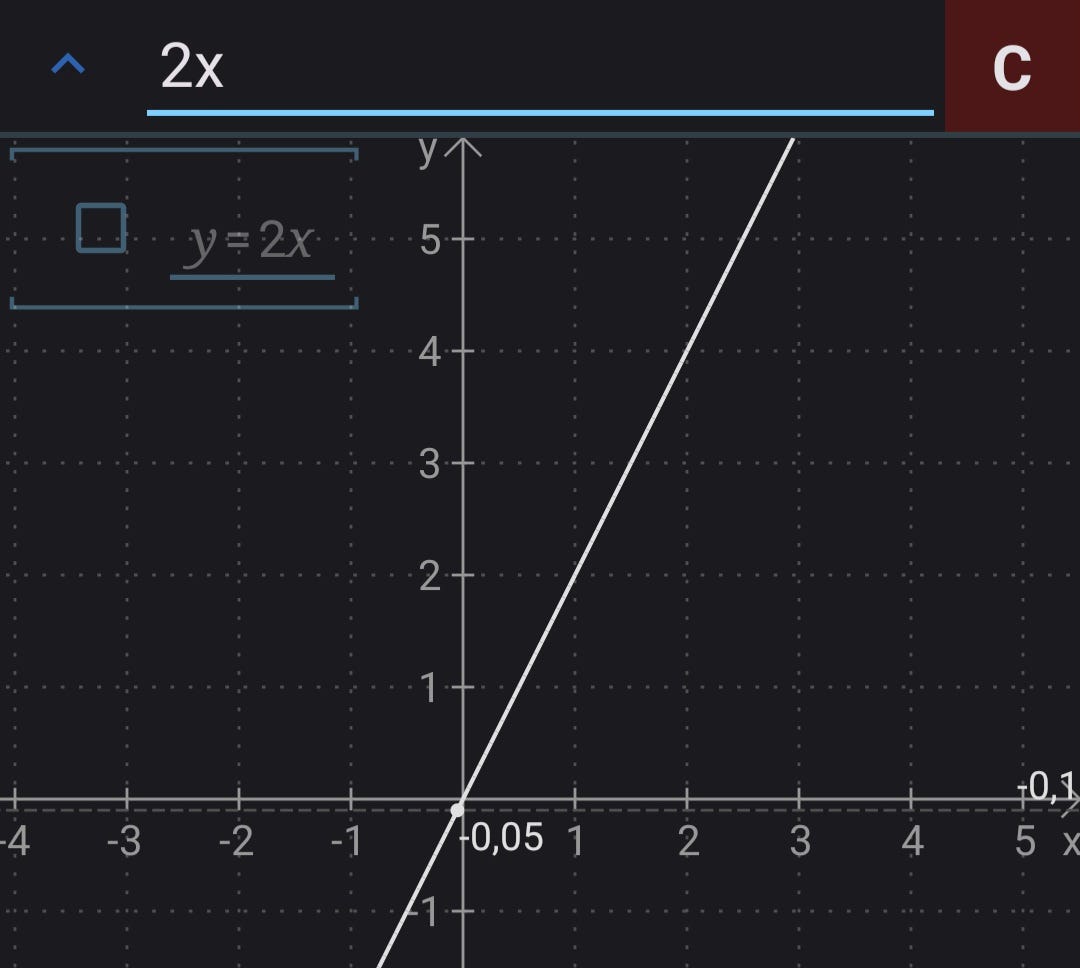
For irrational fractional “x” numbers, there is still a “y” value. It just jumps up and down following the type of number. If “x” (rational) then “y” = 1, and if “x” (irrational) then “y” = 0
There are so many irrational “x” values that there are also many “y” values with high density. Then they just need to be connected and they can be, so why discontinuous?
Here the Dirichlet(x) function affirms the concept of discontinuity (broken/interrupted) which also acknowledges the existence of connectedness between points (unbroken).
🔥 I just want to be more careful in aligning my understanding. And it hasn’t been found yet.
🔥 I want to find out whether the reasoning behind this Dirichlet function is actually only relatively based and then claims there is absolute discontinuity (perceptual failure similar to Georg Cantor) or does Dirichlet truly understand the absoluteness behind the affirmation of his function❓If yes, involving absoluteness, then I need to ensure whether Dirichlet’s concept of discontinuity is the same as my concept of discontinuity.
🔥 Points can be connected ➡️ why is it claimed to be discontinuous? Is this an absolute or relative claim to a certain definition?”
PHYSICS / PHILOSOPHY & MATHEMATICS
🔥 I want to find out whether the reasoning behind this Dirichlet function is actually only relatively based and then claims there is absolute discontinuity (perceptual failure similar to Georg Cantor) or does Dirichlet truly understand the absoluteness behind the affirmation of his function❓If yes
If Dirichlet’s concept of discontinuity is as I understand it in an absolute universal sense, then this is a major breakthrough in mathematics from the perspective of Dirichlet’s thought contribution that maps absoluteness mathematically.
Isn’t absoluteness already commonly known in mathematics by the term “axiom”❓ Yes, but axioms are mathematically considered “self evident” (need not be proven), whereas axioms in the concept of metaphilosophy can be proven (have empirical traces) so that IF THERE IS alignment of concepts between DIRICHLET & METAPhilosophy, then the Dirichlet function becomes an example of understanding philosophical polemics mathematically.
💠 In simpler terms... similar to physicists who, when confused about understanding the connection of physics formulas, turn to mathematicians to translate (convert) from physics language to mathematics language to understand the mystery behind physics (such as black hole detection and others)
✅ HERE OF COURSE IT’S A BREAKTHROUGH WHEN THE DIRICHLET FUNCTION IS TRULY BASED ON THE ABSOLUTENESS OF METAPhilosophy that can be converted, then for the first time❓
✅ Philosophical polemics have their equivalent in mathematics, so that abstract truth becomes more concretely mathematical.
✅ THIS PROVIDES EVEN MORE CONTINUATION LEADING TO SYNERGY BETWEEN PHILOSOPHY & MATHEMATICS LIKE PHYSICS & MATHEMATICS
THE GAP - BETWEEN RATIONALITY & REALISM
It may indeed involve universal absoluteness, but its definition is axiomatically mathematical, thus tending toward rationality whose objectively realistic term has not yet been found in everyday, easily understood language.
Even when a conversion is found from mathematical language to the language of absoluteness, it still poses difficulty in comprehending that absolute language. Yet at the very least, a connecting point has been established between the mathematical (rational) language and its practical counterpart—the language of absoluteness—which actually serves as an intermediary language that facilitates conversion into intellectual language, thereby easing subsequent conversion into a more practical language.
This enables an easier transition from mathematical rationality into a more realistic language.
🔰 SO HOW CAN THE CONCEPT OF DISCONTINUITY IN DIRICHLET BE UNDERSTOOD (Non-Contradictory) IN AN ABSOLUTELY UNIVERSAL SENSE YET REMAIN CONTINUOUS (Connected) AT EVERY POINT